Hibachi at home vs restaurant: the honest comparison

Compare private hibachi at your beach house versus a restaurant teppanyaki table — cost, logistics, guest experience, and when each wins on 30A and Destin.


Overview
· 9 min read · Hibachi Five Star
TL;DR
For groups of eight or more at a 30A or Destin vacation rental, private hibachi at home is usually the better choice: one shared fire show, no waitlist, and an all-in cost that often matches a restaurant once drinks, tax, tip, and rides are counted. A teppanyaki restaurant still wins for two to six people, last-minute date nights, and homes with no outdoor cooking space.
What is private hibachi at home — not delivery, not a rental grill
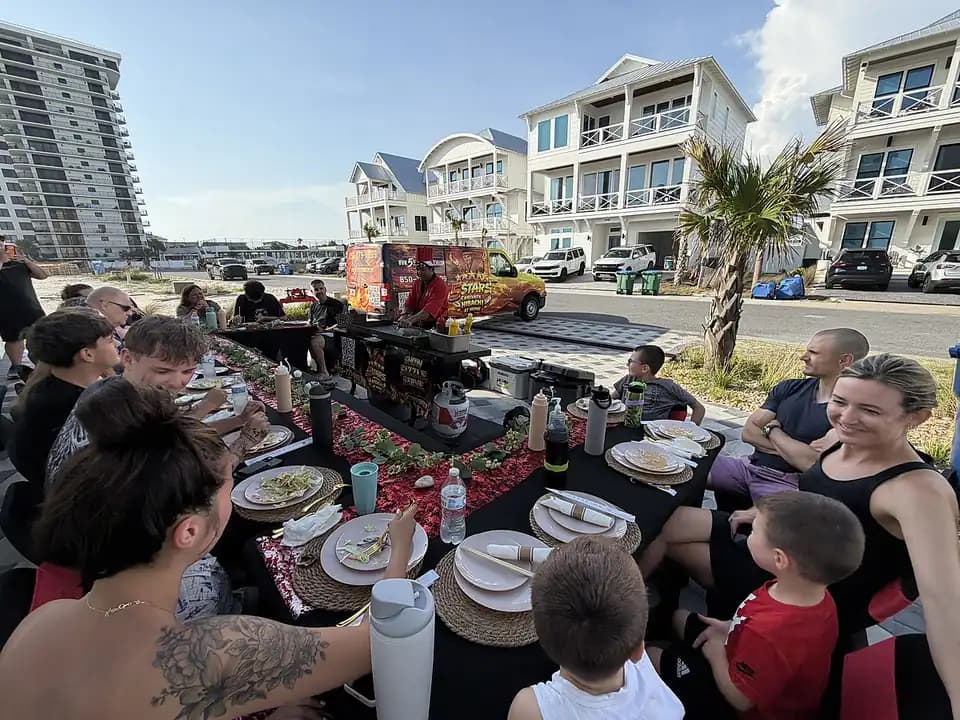
Let's clear up the most common misconception right away. Private hibachi is not a delivery service that drops off lukewarm fried rice in styrofoam containers. It is not a grill rental where you get a flat-top dropped in the driveway and a pat on the back wishing you luck. A private hibachi chef arrives at your vacation rental, backyard, or estate with a commercial-grade flat-top grill, fresh ingredients sourced for your specific headcount, house-made sauces prepared from scratch, and a full live-fire cooking performance that turns dinner into theater. The chef cooks everything in front of your guests — from the first sizzle of garlic butter hitting the steel to the final protein plated and served hot off the grill. The onion volcano erupts. The shrimp fly. The fried rice dances across the surface. And then the chef cleans the entire cooking area and packs out, leaving nothing behind except full guests and a faint, wonderful smell of ginger and toasted sesame.
On the Emerald Coast, this typically unfolds on pool decks, covered lanais, rooftop terraces, and sprawling patios attached to multi-story beach houses from 30A to Destin. These are the same rentals where restaurant logistics become a genuine obstacle — parking garages that charge by the hour, waitlists that stretch past ninety minutes on a Saturday night, kids melting down before appetizers arrive because they've been hungry since five o'clock, and ride-share surges that make a three-mile trip cost more than a steak dinner. When you have twelve people in a seven-bedroom rental on Scenic Gulf Drive, the math flips fast. Getting everyone dressed, loaded into multiple cars because nobody wants to be the designated driver, seated at separate grill tables because the restaurant cannot accommodate a fourteen-top on a peak-season Saturday, and then paying forty-five dollars per person plus drinks plus tip plus the round of sake someone ordered because the wait was so long — suddenly the restaurant-is-cheaper argument looks shaky at best.
Private hibachi rewrites the evening script entirely. The chef arrives roughly an hour before service, stages the grill on an approved flat outdoor surface, and runs through a full setup checklist while your guests are still in the pool, playing corn hole on the lawn, or finishing a sunset walk on the beach. There is no valet line, no host stand confusion, no scanning a QR code for a menu that won't load, and no server hovering at the ninety-minute mark asking if you'd like the check because they need the table for the next reservation. The dinner is the entertainment, and the entertainment is your dinner. When it ends, the chef breaks down the cooking station and removes everything. The host's only job is to provide tables, chairs, plates, utensils, napkins, and a cleared work zone. For groups staying in vacation rentals across Northwest Florida, this transforms what is normally the most logistically frustrating night of the trip into the easiest one — because nobody leaves the house, nobody waits for a table, and nobody argues about who owes what on a split check.
When is a hibachi restaurant the better choice?
Restaurants exist for excellent reasons, and they remain the better choice in several specific scenarios that are worth acknowledging before you book anything. A traditional teppanyaki restaurant wins when you want absolute zero host responsibility: no gate codes to text ahead of time, no seating chart to arrange around a grill footprint, no surface to clear of lounge chairs and pool toys, and no mental energy spent wondering whether the HOA allows open-flame cooking on the lanai after dark. If your idea of a perfect evening involves walking in, sitting down, eating, paying, and walking out without a single logistical thought, the restaurant model was built for you. It also wins for spontaneous two-person date nights or small groups of four to six where nobody needs a main event and everyone is perfectly happy splitting a check once and heading home.
Restaurants also win in specific weather situations that coastal Florida throws at you. If a summer squall is parked over Destin for the entire evening and your rental has no covered outdoor space — no screened porch with overhead clearance, no deep covered lanai, no garage bay that can be ventilated and repurposed — a restaurant with four solid walls and a dry roof is the safer bet. The same calculation applies to groups staying in high-rise condos where the balcony is the size of a postage stamp and the building strictly prohibits cooking on any common-area deck. These edge cases are real, and pretending private hibachi works in every rental under every condition does nobody any favors. A good decision starts with an honest assessment of your space.
That said, the restaurant win column narrows substantially the larger your group grows. Past eight people, most teppanyaki restaurants split your party across two separate grill tables — sometimes on opposite sides of the dining room. Past twelve, you are looking at multiple seatings, staggered reservation times, and the very real possibility that half your group has finished their meal, read their fortune cookies, and is checking their watches while the other half has not even seen the onion volcano ignite. Restaurants are optimized for tables of four to six. Private hibachi is optimized for the whole house — and when your whole house is a vacation rental sleeping sixteen, that distinction is not small. It is the difference between a dinner everyone remembers together and a dinner that half the group missed.
When does hibachi at home win for 30A and Destin groups?
Vacation rentals are purpose-built for togetherness, and that is the arena where private hibachi absolutely dominates. Three generations under one roof in Seaside spread across grandparents, parents, and grandkids? A bachelorette crew of fourteen in a Rosemary Beach carriage-house compound where everyone needs to be in the same photos? Two families splitting a Grayton Beach rental and trying to avoid negotiating seven different dinner preferences every single night of the trip? Private hibachi keeps every single person in the same place at the same time — no splitting the check across four restaurant tables, nobody running late and missing the first course, and no stressed-out host texting the group chat because two couples got lost at the host stand while everyone else is already seated.
You also control every variable that a restaurant controls for you, but on your terms: the exact start time, the music volume and playlist, the dietary accommodations for each guest, and how long people want to linger over drinks and conversation after the last protein leaves the grill. Our service includes full cooking-area cleanup, which means the host is not scrubbing grease off a rental patio at midnight while everyone else has migrated to the hot tub. The chef brings the commercial grill, all cooking ingredients, house-made sauces, and the serving ware needed for the cooking process. The host provides guest tables, chairs, plates, utensils, napkins, and venue access. That full division of responsibilities is designed with one goal: the host actually enjoys the evening instead of managing it like a shift supervisor.
For groups traveling with children, the advantage is sharper still. Kids at restaurant hibachi tables need booster seats rigged on chairs that were never designed for them, constant parental supervision to keep small curious hands away from a searing-hot grill surface, and enough patience to survive a ninety-minute seated dinner without a meltdown — a tall order for a four-year-old who spent the entire afternoon running on the beach. At home, children can watch the show from a safe perimeter that parents define before the chef starts. Parents can assign seating so the youngest kids are positioned safely on outer rows. Nobody has to carry a sobbing toddler through a crowded dining room past tables of annoyed strangers. Children ages five to twelve use the thirty-dollar Rising Star Kids meal — a proper dinner, not a stripped-down half-portion afterthought — and children under five may share an adult meal at no charge. When the show ends, bedtime is thirty steps away across the house, not a thirty-minute drive through summer traffic on Highway 98 with a car full of overtired kids.
Hibachi at home vs restaurant: cost and logistics at a glance
Here is the comparison hosts actually need before they book either option. Restaurant teppanyaki wins on zero setup and indoor weather. Private hibachi wins on one shared show, start time control, and group size. Hibachi Five Star currently starts at $60 per adult, $30 for children ages 5–12, with a $500 event minimum and a $200 deposit. A Destin or 30A restaurant entrée that looks like $35–45 typically lands at $50–75 once drinks, tax, tip, parking, and rideshare are included — and that still assumes the restaurant can seat the whole house at one grill.
| Decision | Restaurant teppanyaki | Private hibachi at home |
|---|---|---|
| Best group size | 2–6 at one grill | 8–20 around one show |
| Wait / start time | 45–90 minutes peak season | Starts at the booked time |
| All-in cost | Often $50–75 per person after drinks, tax, tip, parking, rides | From $60 adult / $30 kids 5–12, $500 minimum |
| Privacy | Shared grill with strangers | Your rental only |
| Dietary control | Limited on a communal grill | Allergies staged before arrival |
| Cleanup | You leave the table | Chef packs out the cooking area |
| Weather | Indoor dining room | Needs a level outdoor surface plus a Florida rain backup |
Restaurant hibachi for twelve to twenty people often looks cheaper per plate on first glance. A thirty-five-dollar dinner special sounds better than a sixty-dollar-per-person private chef package — until you run both scenarios all the way to the bottom line. At a restaurant, that thirty-five-dollar special becomes roughly fifty to fifty-five dollars after one drink, sales tax, and a twenty-percent tip. For a group of fourteen people, you are now at seven hundred to seven-hundred-seventy dollars before anyone orders a second round of drinks or a dessert. And all of that assumes the restaurant even seats fourteen people together at one grill table — which, on a peak-season Saturday night in Destin or along 30A, is far from guaranteed.
Now run the private hibachi numbers. Our Platinum Stars package starts at sixty dollars per adult, with a five-hundred-dollar event minimum and a two-hundred-dollar deposit to hold the reservation. For ten adults, that is six hundred dollars before any protein upgrades, service charge, sales tax, and any applicable distance fee for locations more than fifty miles from our base. That six hundred dollars feeds ten people a full multi-course dinner with two proteins each, fried rice prepared fresh on the grill, grilled vegetables, a starter salad, house-made dipping sauces, and a live cooking performance — plus professional setup and cleanup. The per-person difference between the restaurant and the private experience is often negligible once you back out restaurant drinks, tips, and rideshare costs. And the experience gap — a private show on your own deck with your favorite people versus a shared table in a loud dining room with strangers on both sides — is not something you can easily price in dollars and cents.
For peak 30A weekends and holiday weeks, private hibachi experiences sell out because they solve the single hardest problem in group vacation planning: feeding a full house well without losing half the night to logistics. When you factor in the value of time — no driving, no searching for parking, no waiting for a table to open, no coordinating separate Venmo requests across seven couples — the cost comparison tilts further toward the private option every time the group exceeds eight people. This decision is not about finding the absolute cheapest meal possible. It is about finding the best value for a shared memory that everyone genuinely enjoys instead of endures.
The hidden costs of restaurant dining nobody talks about
Beyond the menu prices, restaurant dining in a busy beach town carries hidden costs that quietly inflate your final total. Parking in Destin during peak summer months often costs ten to twenty dollars per vehicle at public lots near popular restaurant districts. For a group arriving in three or four cars, that is thirty to eighty dollars in parking before anyone has looked at a menu. Ride-share services surge during dinner hours, particularly on Friday and Saturday nights, turning a two-mile ride into a thirty-dollar fare each way. Multiply that by two or three cars and both directions, and transportation alone can add a hundred dollars or more to the evening — money that buys exactly zero food, zero drinks, and zero memories.
Then there is the time tax. A ninety-minute wait for a table for twelve people during peak dinner hours is not unusual — it is the norm. That wait time gets filled with expensive bar drinks because your group has nowhere else to go, kids getting restless and hungry, and the general erosion of everyone's patience. By the time you sit down, you have already spent money and mood. With private hibachi, the start time is the start time. Guests walk out of the house onto the deck, sit down, and the show begins. The money you would have spent on parking and surge-priced rides stays in your pocket, and the hour-plus you would have spent waiting gets invested back into the evening — more time laughing, eating, and enjoying the people you traveled to spend time with in the first place.
Dietary needs — restaurant limitations versus private flexibility
Restaurant teppanyaki kitchens operate on assembly-line efficiency. A chef cooking for twelve strangers at a communal table has limited flexibility to customize individual plates, modify cooking sequences for allergy safety, or slow down to accommodate a guest who needs detailed ingredient information. Gluten-free soy sauce might not be available. Cross-contact between shellfish and other proteins happens on a shared grill surface that saw shrimp five minutes ago. A vegetarian at a restaurant hibachi table often gets a sad vegetable plate cooked as an afterthought on a corner of a grill still slick with meat drippings.
Private hibachi operates on a completely different model. Because every plate is cooked for your specific group, dietary needs are communicated before the chef arrives and incorporated into the cooking plan. The chef can sequence proteins to avoid cross-contact — cooking chicken and vegetables first on a clean grill section, then moving to shellfish last. Gluten-free tamari replaces soy sauce seamlessly. Vegetarian guests get a dedicated portion of the grill with fresh oil and their own set of vegetables, rice, and tofu or additional produce cooked with the same care as every other plate. This level of customization is simply not available in a restaurant setting where the chef is cooking for three different parties simultaneously, each with competing timelines and preferences.
The atmosphere factor — intimacy versus anonymity
There is a fundamental atmospheric difference between the two experiences that goes beyond cost and convenience. At a restaurant, you are sharing a grill table with strangers. Their conversation bleeds into yours. Their phone notifications ping during your toast. Their dietary preferences dictate the cooking order. The chef performs the same scripted show they have performed six times that evening, and while it is entertaining, it is not yours. At your rental, the show is exclusively for your group. The chef reads the room — knows which jokes land with your crew, knows the birthday girl is in the center seat, knows the kids are fascinated by the fire tricks and should get a little extra attention. The jokes are inside jokes by the end of the meal.
This atmosphere difference matters most for milestone events. A bachelorette dinner where the bride is just another face at a restaurant table versus a bachelorette dinner where the bride is the center of the experience — those are not the same memory. A family reunion where grandparents at one end of a long restaurant table cannot hear the grandchildren at the other end versus a family reunion where everyone sits in a U-shape around a single grill, watching the same show, reacting to the same moments — those are not the same evening. Private hibachi creates a shared focal point around which the entire group coalesces naturally. Restaurants create parallel experiences that happen to occur in the same building at roughly the same time.
The bottom line — which one is right for your group?
Choose a restaurant for low-friction date nights, spontaneous small-group outings, and situations where you genuinely want someone else to handle every logistical detail and the premium price for that convenience is worth every penny. Choose hibachi at home when the house is the venue and the dinner is the entertainment — when you have a group that would rather laugh together on a private deck than navigate a packed Destin parking lot at six-thirty on a Friday evening. Choose the restaurant when you are a party of four who can walk in, sit at the grill, and walk out in under ninety minutes. Choose private hibachi when your party is ten or more and you want one shared experience rather than two separate tables and a split-check headache.
If you are hosting on 30A, in Destin, Santa Rosa Beach, Miramar Beach, or anywhere along the Emerald Coast, private hibachi almost always delivers more memories per guest, more control over the evening flow, and a total cost that competes favorably with restaurant dining once you account for everything that restaurant dining actually costs in a busy beach town. The question is not simply which option is cheaper on the menu. The question is what kind of night you want to remember — and whether you would rather be the group that stayed in, gathered around the grill, and got the full show, or the group that spent half the evening waiting in an Uber line watching your reservation time come and go while your hungry kids asked when dinner would start.
Ready to bring the show to your beach house? Explore our hibachi at home service to see how it works, review the full breakdown on our menu and pricing page, or open the Panama City Beach hibachi page for PCB rental and condo-planning details. Then book your private chef before your preferred date fills.
Frequently asked questions
Is hibachi at home cheaper than a restaurant?
How many people is hibachi at home best for?
When should we still go to a hibachi restaurant?
Is private hibachi the same as making hibachi at home yourself?
Verified customer feedback
Read these reviews on Google Maps
“The best experience! We loved it for a bride to be!”
Alexandra Wyman
Google Maps · 5-star review
Open this review on Google Maps
“10 stars for 5 Star Hibachi!!! They couldn’t have been more fun, kind, prepared + the food was delicious!!! Highly recommend for at home hibachi ❤️”
Ansley Porter
Google Maps · 5-star review
Open this review on Google Maps
“They are so fun! Great food too. Dinner and a show”
Delaney
Google Maps · 5-star review
Open this review on Google Maps
Review source: Read all reviews on Google Maps