Deposits, cancellation, and weather policies explained

Plain-English guide to hibachi deposits, cancellation windows, and coastal weather plans so hosts on 30A and Destin can book with confidence.

Overview
· 7 min read · Hibachi Five Star
TL;DR
Hibachi Five Star takes a $200 deposit credited to the event total. Seven or more days’ notice: deposit is refundable. Two to six days: usually a same-season credit if the slot can be rebooked. Under 48 hours: deposit is non-refundable. Brief summer squalls rarely cancel a covered-lanai dinner; named tropical systems are handled as safety-first reschedules or refunds.
Why deposits exist — and why they protect both sides
Peak coastal weekends on 30A and Destin have finite chef capacity — there are only so many trained hibachi chefs, so many commercial grills, and so many Saturday evening slots available in a given week. When you book a date with Hibachi Five Star, we block that chef's entire evening on the calendar, begin ingredient sourcing and procurement for your specific confirmed headcount, and turn away every other inquiry that comes in for that exact time window. The deposit is what makes that commitment mutual and binding. Without a deposit sitting on the calendar, a reservation is just a conversation that either side can walk away from without consequence — and we have seen too many groups book a house six months in advance, mentally assume dinner was handled, and then reach out two weeks before the trip only to discover every Saturday in June was claimed back in February.
Our deposit is two hundred dollars — a meaningful amount that signals commitment without being punitive or creating financial anxiety for the host. The deposit is applied directly toward your final event balance, not added as an extra fee on top of the package total. Think of it as the down payment that moves your group from the "we should probably book hibachi" phase to the "we booked hibachi and the date is ours" phase. The remaining balance is handled according to the payment terms confirmed at booking, and every charge beyond the deposit — package totals, upgrades, service charges, tax, and any distance fees — is disclosed and itemized before the deposit is collected so there are zero surprises on the final invoice.
Is the hibachi deposit refundable — cancellation windows
Life happens — flights get rescheduled, vacation rentals fall through due to owner cancellations, group sizes shift dramatically, and unexpected circumstances sometimes force a change of plans. Our cancellation policy is built around three clear time windows that reflect how much lead time the chef needs to rebook the slot and recover the cost of ingredient sourcing. With seven or more days of notice before your event date, your deposit is fully refundable with no questions asked and no hoops to jump through. That gives the calendar a full week to reopen the date for another group, and the chef's schedule can be adjusted without any stranded commitments to ingredients or staffing.
With two to six days of notice, we are operating in a tighter window where ingredients may already be on order or partially sourced for your specific headcount, and finding a replacement booking midweek for a weekend date is significantly more challenging. In this range, the deposit is typically non-refundable but may be applied as a credit toward a rescheduled date within the same season, depending on current calendar availability and whether the original slot can be filled. We evaluate every situation in this window case by case — if we are able to rebook the date with a different group, we will absolutely work with you on applying your deposit to a future event.
Less than forty-eight hours before the event is the hardest cancellation window for any private chef service to manage. Food has been purchased, ingredients have been prepped, the chef's schedule is fully locked, and rebooking the slot is functionally impossible on such short notice. In this tier, the deposit is non-refundable and the full event balance may be due depending on the preparation status at the time of cancellation. We do not enjoy delivering that news any more than you enjoy hearing it, which is exactly why we communicate proactively and frequently as the event date approaches — a quick confirmation check-in a few days out prevents the last-minute scramble that leads to the worst outcomes for everyone involved.
Northwest Florida weather — what actually matters and what does not
The Emerald Coast experiences two distinct weather patterns that every host booking an outdoor hibachi dinner needs to understand. The first pattern is the classic summer afternoon thunderstorm — skies stay clear through the morning, clouds begin building by early afternoon, a downpour rolls through somewhere between three and five o'clock, and the sky typically clears completely by sunset. These storms are intense while they last but brief in duration, and they very rarely cancel an evening hibachi dinner. A covered patio, a deep lanai with adequate overhead clearance, or a flexible thirty-minute delay to the start time solves the overwhelming majority of summer weather calls along 30A and Destin.
The second pattern is the tropical system — a named storm, hurricane, or sustained severe weather event that makes outdoor cooking genuinely unsafe regardless of whether overhead cover is available. These situations are handled entirely differently and with absolutely zero debate or ambiguity: safety is the first, last, and only priority. We monitor tropical weather forecasts continuously during the Gulf storm season and reach out proactively to hosts if a system is tracking toward the Panhandle. Tropical weather in the Gulf typically provides days of advance warning rather than hours, so these calls are virtually never last-minute surprises. We will work directly with you on rescheduling or processing a refund based on the severity, projected track, and expected timing of the system relative to your event window.
One important distinction worth internalizing before you start anxiously watching weather apps: overcast skies, light drizzle, and scattered showers with low precipitation probability are not cancellation weather. If the commercial grill can operate safely and guests have overhead cover, the show proceeds as planned. Some of our best event photos — the ones with dramatic moody skies, string lights reflecting off damp deck surfaces, and the orange glow of the grill fire against a darkening Gulf horizon — come from evenings that looked threatening on the hourly forecast but produced beautiful, memorable conditions.
Covered backup options — the single best defense against weather anxiety
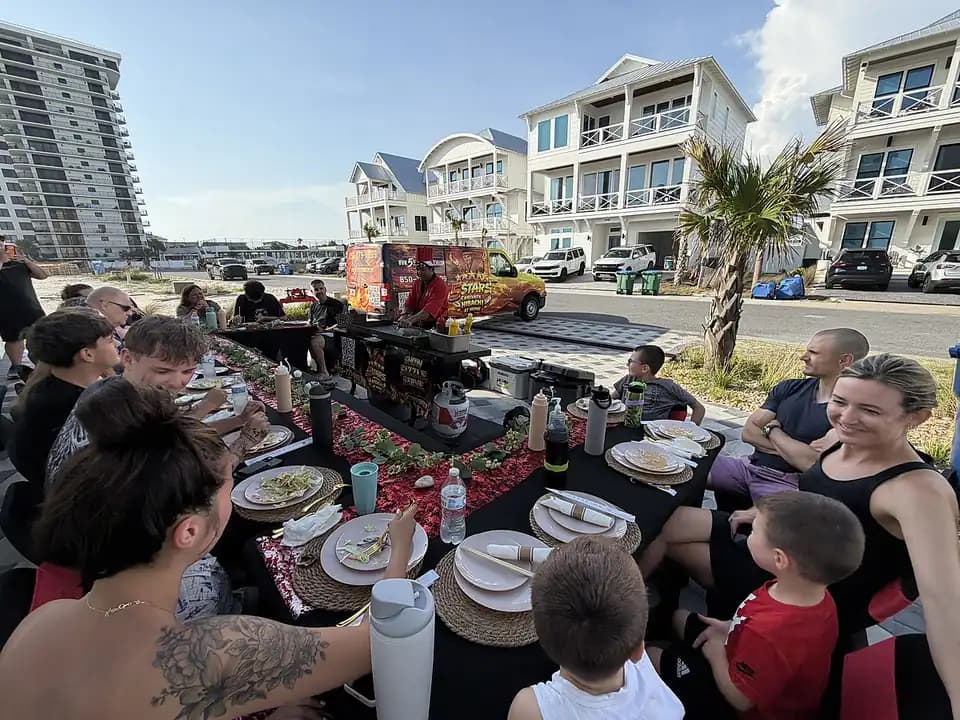
The most effective strategy for eliminating weather-related stress around your hibachi booking is identifying a covered cooking surface at your rental before the date is confirmed. Most 30A and Destin vacation rentals come with at least one of these weather-resistant options: a screened or covered lanai with adequate headroom, a deep covered porch that extends far enough to shield the grill station and the seating area, a garage with open bay doors that can be ventilated and cleared, or a pool deck with a permanent pergola or roof structure. When you book, share details and photos of your outdoor spaces with the booking team — the chef can identify which surface works best for the grill configuration and whether any adjustments to the standard setup are needed for your specific property.
For vacation rentals that lack adequate overhead cover, a pop-up canopy or event tent is a practical and affordable backup solution. Several local equipment rental companies on the Emerald Coast offer party tents for same-day or next-day delivery, and the rental cost is modest compared to the alternative of losing a dinner slot to weather uncertainty. If a tent is not practical for your specific configuration — perhaps your deck is too small, your HOA prohibits temporary structures, or the forecast genuinely looks dangerous rather than merely inconvenient — discuss the full range of options with the booking team well ahead of the event date. The most important principle is having the weather conversation before the forecast looks threatening, not when lightning is already visible over the Gulf and decisions need to happen fast.
Reschedule versus refund — how we prefer to handle disruptions
When weather events or unexpected travel complications impact a booking, our strong preference is rescheduling over refunding because it preserves your event on the calendar, keeps the chef's time productive rather than wasted, and ultimately delivers the experience your group booked in the first place. If your group has any flexibility — perhaps you are staying for a full week and the dinner can shift from Saturday to Sunday, or your beach trip can slide one weekend in either direction without major logistical conflict — rescheduling preserves the full value of your deposit and gets you the exact same experience on a different day that works for everyone.
Refunds are processed according to the cancellation tier that applies at the time you notify us of the change. We do not hold deposits hostage, make you jump through administrative hoops, or delay processing as a negotiation tactic. If a refund is due under the terms of your booking, it is issued promptly through the same payment method you used for the deposit. If a tropical storm warning is officially issued for our service area and your event date falls within the warning window, we treat that as a force-majeure scenario that supersedes the standard cancellation tiers and offer either a full refund or priority rescheduling at your choice with no penalty or pressure either way.
Real scenarios — what hosts actually experience
Scenario one: A bachelorette group of twelve is booked for Saturday evening at a rental in Seaside. Friday evening, the forecast calls for a sixty-percent chance of scattered thunderstorms from three to six in the afternoon. The rental has a deep covered porch with a ceiling fan and string lights. The group decides to proceed as planned — the storm passes through by four-thirty, the chef arrives at five-thirty for setup, and dinner unfolds under completely clear post-storm skies with a stunning sunset that none of the weather apps predicted. Scenario two: A family reunion in Destin is booked for a Wednesday in September. A tropical storm in the Gulf is projected to make landfall within forty-eight hours somewhere along the Panhandle. We reach out proactively on Monday morning — two full days before the event — and offer the family the choice of rescheduling to Thursday or Friday once the system has cleared, or accepting a full refund. The family chooses Thursday, the storm clears by Wednesday morning, and dinner runs without a single hitch or delay.
Scenario three: A birthday party for fifteen people was booked two weeks in advance. The host cancels on Tuesday for a Saturday event — four days of notice, which falls in the two-to-six-day cancellation window. The deposit is non-refundable at this tier per the written policy. However, another inquiry for the same Saturday date came in overnight, and we are able to rebook the slot within hours of the cancellation. Because the slot was successfully filled, we apply the original host's deposit as a credit toward a new date later in the month. Everyone reaches a good outcome — but only because the host communicated clearly and early rather than waiting until the last minute and hoping for a different result. Early communication is the single variable that most consistently turns a bad cancellation scenario into a manageable one.
Host weather-readiness checklist and final booking guidance
When you book your hibachi dinner, confirm your covered cooking surface and share photos of the outdoor area with the booking team. Note whether the cover is a solid permanent roof (handles rain reliably) or fabric such as an awning or pergola (handles sun and light mist but is not designed for sustained downpours). Identify a backup indoor or covered transitional space — a garage bay, a wide covered hallway, a deep porch, or a covered entryway — that could function as a fallback cooking location if conditions require an unexpected adjustment. Begin checking the forecast approximately five days out from your event date, but do not panic at the first appearance of a rain icon. Monitor the hourly breakdown rather than the daily summary icon — afternoon storms that clear by early evening are the norm in this climate, not the exception.
Reach out to us at least forty-eight hours before your event if you have any weather-related concerns, and we will discuss the full range of options based on the specific forecast, your property configuration, and the chef's schedule flexibility. Keep the communication channel open — a quick phone call or text message the day before the event answers more questions and resolves more anxiety than a frantic voicemail left two hours before the scheduled start time. Read our full cancellation policy for complete terms, check the FAQs page for quick answers to common booking questions, and when you are ready to lock in a date with confidence, book your private hibachi dinner. Call 850-779-8899 to speak with the team directly about any policy questions before you commit.
Frequently asked questions
Is the $200 hibachi deposit refundable?
Does rain cancel a private hibachi dinner in Florida?
What happens if a hurricane or tropical storm hits?
Verified customer feedback
Read these reviews on Google Maps
“The best experience! We loved it for a bride to be!”
Alexandra Wyman
Google Maps · 5-star review
Open this review on Google Maps
“10 stars for 5 Star Hibachi!!! They couldn’t have been more fun, kind, prepared + the food was delicious!!! Highly recommend for at home hibachi ❤️”
Ansley Porter
Google Maps · 5-star review
Open this review on Google Maps
“They are so fun! Great food too. Dinner and a show”
Delaney
Google Maps · 5-star review
Open this review on Google Maps
Review source: Read all reviews on Google Maps